

Technology does not need authorization to proceed. The devices are now immediate and the user is always expecting speedy and dependable results. That change did not occur by accident, as systems required a more intelligent approach to data processing, closer to its generation. This is where Edge AI comes in to play. This does not send information to remote servers but instead does it locally on the devices. Consequently, activities become quicker, privacy is enhanced, and systems are made more effective. Also, the industries are utilizing the method to process real-time issues instantly. In this article, you will clearly know what Edge AI is, its working, why it is rapidly growing and where it is applied in real life. You will also find out the comparison with the cloud systems and why it will determine the future of intelligent technology.
What is Edge AI?
Edge AI becomes easier when you look at how devices operate today. In simple terms, it means the direct execution of artificial intelligence on such devices as smartphones, cameras, sensors, and machines. These devices process data locally as opposed to relying on cloud servers. This strategy is important as it decreases the time of delay and enhances performance. When data is processed close to a system, it responds in real-time. An example is facial recognition on a phone, which can be done fast since the calculation is performed on the phone. Thus, the users are faster and smoother in their interactions. In addition, it enables systems to operate in instances of weak or no connectivity to the internet. This consistency renders it applicable in the most demanding settings like healthcare and transportation.
Why Edge AI Is Growing Across Industries?
Several technological advancements are leading to the fast development of Edge AI. Artificial intelligence models have developed over the years to be stronger and more efficient. Meanwhile, hardware has become much better and devices can perform complicated calculations on their own.
Moreover, the emergence of the IoT devices has generated large quantities of data. Not all of that data can always be efficiently sent to the cloud, so businesses tend to prefer its processing on their own. Thus, it has become an automatic way of dealing with real-time information.
Key Growth Factors
- Better neural networks which process complex information.
- State-of-the-art local computation processors.
- IoT devices that produce continuous data expand.
- Quick connection with 5G networks.
For instance, a manufacturing unit now uses smart sensors to monitor machines continuously. Consequently, it identifies errors in the early stage and minimizes downtime. This transformation demonstrates that Edge AI enhances smarter processes.
How Edge AI Works in Real-Time Environments?
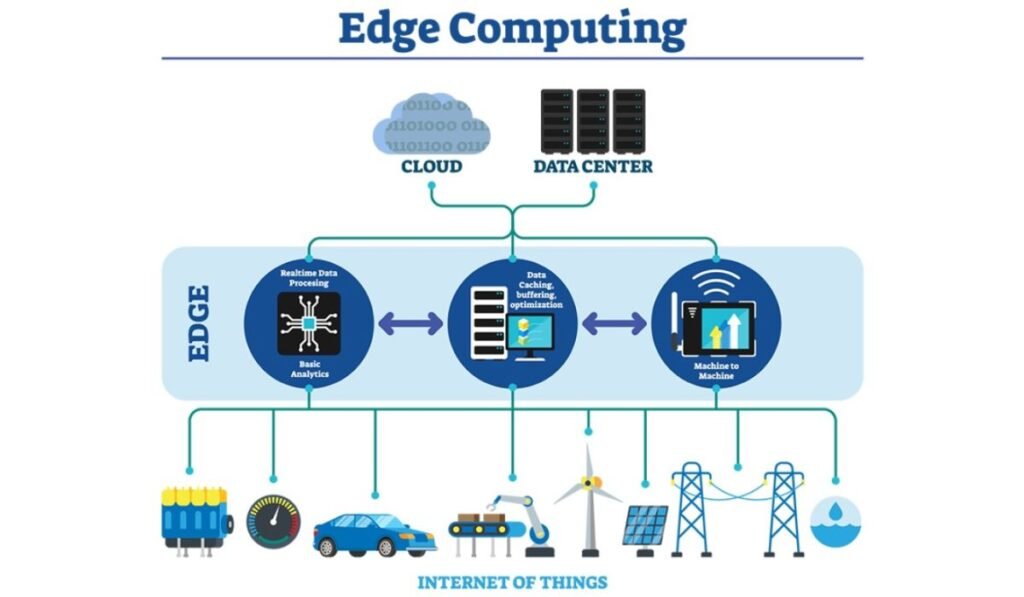
To understand how Edge AI works, you need to follow its process step by step. Even though the process is high-tech, the workflow is developed and simple to follow. First, devices gather information about real-world environments. Then, AI models are trained using large datasets, usually in cloud systems. These models are implemented on edge devices after training. After deployment, the device runs some data at the point of deployment and sends immediate data.
Workflow of Edge AI
| Stage | Explanation |
| Data Input | Devices collect real-world data |
| Training | AI models learn patterns |
| Deployment | Models move to edge devices |
| Inference | Devices give instant results |
| Feedback | Models improve over time |
This is a way of guaranteeing that systems are continually enhanced. Indicatively, an autonomous automobile applies Edge AI to identify obstacles in real time. Thus, it responds fast without cloud instructions. Besides, the system can also retrain the new data when it comes across it. Consequently, the model is more precise in a long term.
Benefits of Edge AI for Speed and Privacy
The practical value of Edge AI is one of the primary factors why businesses embrace it. It positively influences the performance, cost reduction, and the security of data directly.
1. Real-time processing improves response speed
Local processing devices have the ability to respond immediately without the need to connect to the cloud. This lessens delays and assists systems to operate effectively in time-sensitive scenarios. As an example, scans are analyzed instantly using medical devices, which facilitates quicker decisions. This leads to smoother and more reliable interactions among the users.
2. Lower bandwidth usage reduces operational costs
By making sure that systems do not transmit huge quantities of data to distant servers, systems save on network resources. This decreases the data transfer costs of businesses. Besides, organizations are able to scale systems at a lower cost without the need to scale up infrastructure. Thus, local processing becomes a solution that is cost-effective.
3. Local data handling enhances privacy
Sensitive data is stored on the device rather than moved through networks, and this enhances security. This will minimize the possibility of data breaches and unauthorized access. Besides, it helps in adherence to privacy laws. This will lead to increased confidence among users using such systems.
4. Systems remain functional without internet
The devices keep on functioning even when there is limited or no connectivity. This is very important in places such as factories or faraway places. Moreover, continuous operation guarantees homogeneity of performance. Therefore, systems are made more reliable during critical situations.
5. Continuous learning improves accuracy
The systems are enhanced through new data and feedback over time. As devices are exposed to new situations, they improve on their models to achieve better results. This continuous advancement improves performance without the need to update it manually all the time. This leads to the creation of smarter systems.
Real-World Applications of Edge AI Technology
You interact with Edge AI more often than you realize. It is already present in many everyday systems, and its role continues to expand across industries.
Common Use Cases
- AI is used in healthcare for real-time diagnosis.
- Predictive maintenance is dependent on manufacturing.
- Smart shopping is done by using voice assistants in retail.
- Forecasting systems are used in the energy sector.
- Autonomous systems are involved in transportation.
An example is a smart camera that is used in a retail shop and detects suspicious behavior immediately. Consequently, it improves timely security.
Edge AI and Cloud AI Working Together
Edge AI can be used alone, but in many cases, it is combined with cloud systems. Both technologies complement each other instead of competing. Model training and updates that involve large-scale training and updating are done by cloud systems. Meanwhile, edge devices perform local tasks at a higher response time. Thus, a combination of the two forms a balanced and effective system.
Edge AI vs Cloud AI
| Feature | Edge AI | Cloud AI |
| Speed | Fast | Slower |
| Data Location | Local | Remote |
| Connectivity | Optional | Required |
| Scalability | Limited | High |
The mixture enables the businesses to leverage the advantages of the two systems. The example is that a voice assistant can handle simple commands but forwards complex queries to the cloud.
Conclusion:
Edge AI is changing the way devices process information and the way they communicate with users. This makes the intelligence more in touch with the source enhancing speed, privacy, and efficiency. In addition, it facilitates real-time decision making in industries, which makes systems more reliable and responsive.
With the increasing use of smarter technologies in businesses, the use of Edge AI will only become more powerful. Thus, playing with the current Edge AI will enable you to keep up with the rapidly evolving digital environment today.