


When individuals hear about the AI tools, most of them assume that they are identical but that assumption is soon disproved as the individuals use them in their everyday life. Big productivity gaps are created in small differences in real work. It will be apparent comparing Claude vs. ChatGPT that both tools perform in different ways when it comes to the pressure. As an example, one of the tools enhances faster during a long coding process or serious research mission, whereas the other one emphasizes explanation. This leaves your workflow either satisfying or exasperating.
In addition, professionals are not just in need of answers; they are in need of trustworthy systems. When a tool cannot keep the context or repeats errors, it increases the speed. Thus, it is necessary to learn about Claude vs. ChatGPT when anyone operates in the field of data science, content creation, or another technical field. It is not necessary to guess but rather the two tools should be used strategically depending on the task at hand.
Claude vs. ChatGPT for Everyday Answers and Speed Performance
In a technical landscape presentation, there is not much need of lengthy explanations but for shortened ones. Here, a difference in the manner of response is noticeable in Claude vs. ChatGPT. Claude gives straight responses and this aids in cases where you already know the subject matter. ChatGPT, on the other hand, elaborates answers with further details, facilitating studying at the cost of time.
An example of this is when answering questions such as SQL joins, or puzzle interpretation of the confusion matrix, Claude answered in a clear and concise manner. Meanwhile, ChatGPT described the rationale behind every idea in great detail. So you will decide on the purpose of your decision. Claude works better in case you want speed. ChatGPT can be more helpful if you would like to get an understanding.
Quick Answer Comparison
| Feature | Claude | ChatGPT |
| Response style | Short and direct | Detailed and explanatory |
| Speed | Faster | Slightly slower |
| Context depth | Minimal unless asked | Built-in explanation |
The rule is as followed by numerous professionals in practice. Claude they rely on to answer fast questions and ChatGPT to clarify concepts. This will save time and will decrease thinking friction.
Claude vs. ChatGPT for Data Science Coding and Debugging Tasks
The actual difference can be observed through the coding as it involves logic, structure, and accuracy. Comparing Claude vs. ChatGPT in the coding process, Claude is a partner who acts collaboratively. Before it produces code, it tends to pose clarify queries, enhancing precision. ChatGPT, however, is much faster in generating code, but can also add unnecessary steps or extra libraries.
As an illustration, when Claude was involved in a data cleaning task in Python, he created clean and structured code. In the meantime, ChatGPT provided a functional solution but introduced a side of complexity not necessary. Hence, both instruments will be able to resolve issues but Claude is efficiency-oriented and lucid, and thus it is more effective on the production level.
Coding Performance Breakdown
| Feature | Claude | ChatGPT |
| Code quality | Clean and optimized | Functional but verbose |
| Debugging | Improves logic and structure | Fixes errors clearly |
| Workflow efficiency | Smooth and structured | Requires manual refinement |
Additionally, the two tools diagnosed the problem during the SQL debugging tests. Nonetheless, Claude proposed to optimize queries to enhance the performance and readability. Because of this, the developers took less time in correcting mistakes and also enhanced quality of the code.
Claude vs. ChatGPT for Content Writing and Personal Brand Growth
The process of content creation involves not only creating text. It requires tone control, consistency and context sensitivity. A distinct difference can be found in Claude vs. ChatGPT in this area. Claude still has a consistent voice in long-form content, whereas ChatGPT is great at producing new ideas within a short period of time.
Indicatively, when Claude writes LinkedIn posts or newsletters, he gets used to your writing style as time goes by. This renders it applicable in personal branding. Conversely, ChatGPT provides numerous variations, which can be used in brainstorming. But it can lack consistency in tonality in longer content units.
Claude vs. ChatGPT for Deep Research and Document Analysis
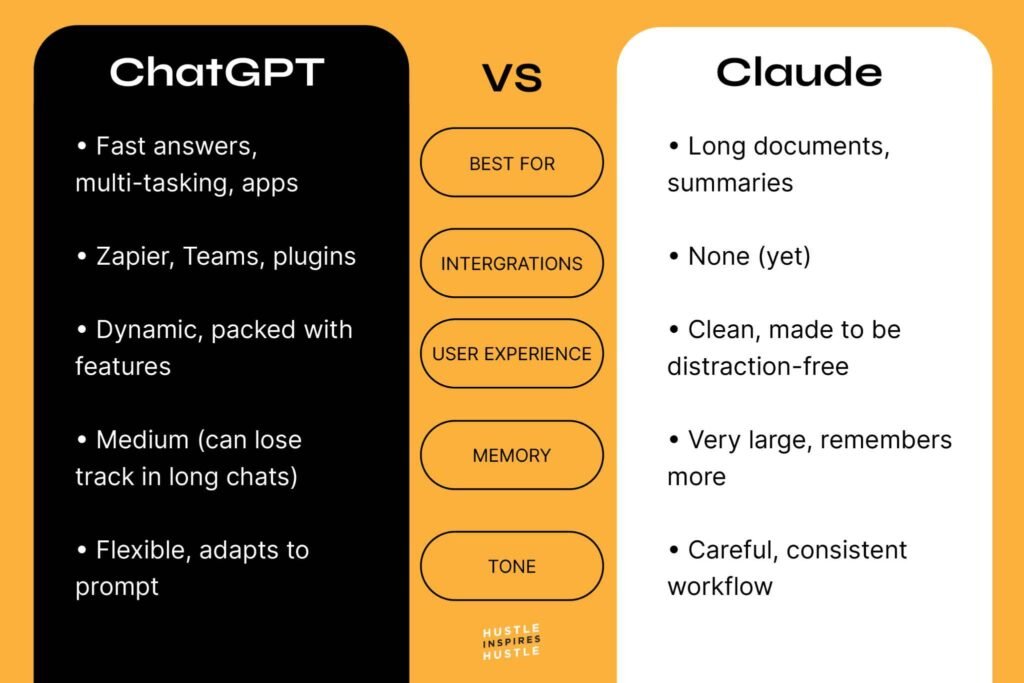
This comparison is even more significant due to the amount of information that needs to be worked with when conducting research. Claude would be more effective than ChatGPT in research since it is more efficient over long documents. In contrast, ChatGPT frequently takes several prompts to get to the same depth.
Indicatively, in the course of research analysis, Claude finds patterns, summaries findings and gaps in a single output in a structured manner. At the same time, ChatGPT is step-by-step, which adds to the time of interaction. Consequently, Claude is more effective during not-so-easy research activities.
Claude vs. ChatGPT Workflow Strategy for Maximum Productivity
One of these tools is not the most intelligent thing to choose. Rather, a combination of the two tools forms a more efficient workflow. When you have the Claude vs. ChatGPT concept, you will be able to allocate tasks according to competencies. This is a way of minimizing work and maximizing the quality of output.
You can use yourself as an example of what you can think about, and then you can have Claude, who will do tasks related to executing like coding or structured writing. Then you can use ChatGPT to brainstorm or conceptualize things. This workflow will keep you in control and make good use of AI.
Practical Workflow Approach
A simple workflow can help you get the best results:
- State the problem.
- Output using Claude in a structured way.
- ChatGPT can be used to explain and get ideas.
- Check and proofread all findings.
This is effective since it is a balance between being fast and at the same time understanding. You will live without relying on a single tool and have greater control over what you do.
Claude vs. ChatGPT Common Mistakes That Reduce Efficiency
Most users expect perfect outputs, yet they forget that AI still needs guidance. In cases where individuals are over-dependent on the automated responses, they tend to add more trouble rather than curb the situation. Thus, it becomes crucial to be aware of the pitfalls in case you desire to achieve better outcomes and to have fewer hassles in your processes.
1. Blindly trusting generated output
Most users blindly copy answers and do not have to take time to look at them and this results in undetected errors in the code or logic. In spite of the fact that AI generates confident answers, it can still overlook significant details. As such, the verification of each output guarantees that there are no errors and mistakes that are expensive to correct.
2. Skipping manual verification steps
In the cases when users do not perform validation, they lose the control over the quality of their work. Indicatively, the execution of unverified SQL queries can shatter datasets or give erroneous insights. Consequently, manual review of the outputs ensures that your workflow is effective and coherent.
3. Using one tool for every task
There are users who rely on one AI tool to perform everything, which reduces efficiency. Each tool possesses its strong points; therefore, the utilization of one of tools decreases the performance in particular aspects. Thus, the use of alternative tools according to the task enhances the general productivity.
4. Ignoring context limitations
The use of AI heavily relies on the context, and users frequently do not take it into consideration. An incomplete context results in inaccurate or irrelevant outputs. Therefore, ensuring input is obvious and the limitations are known enhances the quality of the responses.
Claude vs. ChatGPT Future Trends in AI Workflows
The future of AI tools is not competitive. It is concerning integration. Examining the trends of Claude vs. ChatGPT, one can clarify that each of the tools will further develop depending on the needs of the users. Structured workflows are likely to be worked on better by Claude, whereas conversation will be enhanced by ChatGPT.
Furthermore, practitioners are already inclined to the hybrid workflows. They integrate tools depending on the task as opposed to using a single platform. Such a change demonstrates the fact that the actual advantage is flexibility. Thus being familiar with the two tools in our times is a forecast of the changes in the future.
Claude vs. ChatGPT: Final Verdict Based on Real Testing
Claude vs. ChatGPT can be easily concluded. Claude tends to be more useful in execution related tasks such as coding, writing and research. ChatGPT is superior in the learning and brainstorming fields and exploring ideas. Thus, it is not wisest to make a choice between them.
Rather, you ought to establish a workflow that employs both tools in a calculated manner. This method increases the productivity, minimizes errors and boosts learning. Consequently, you do not have to work harder to get improved results.
Conclusion:
The Claude vs. ChatGPT is not about a winner since both tools are effective in addressing various problems in real workflows. Claude is ideal in terms of coding, research, and long writing because it is centered on the aspects of execution, structure, and efficiency. Alternatively, ChatGPT allows learning, brainstorming, and clarity of concepts, which encourage users to learn better and explore ideas.
A combination of the two tools is, therefore, the best way ahead as opposed to use of either. By strategically employing Claude vs. ChatGPT, you can make your working process well balanced, resulting in higher productivity and fewer mistakes. This way, you are still in charge and use AI as a potent partner in your work.
Also Read About :- Edge AI Computing