

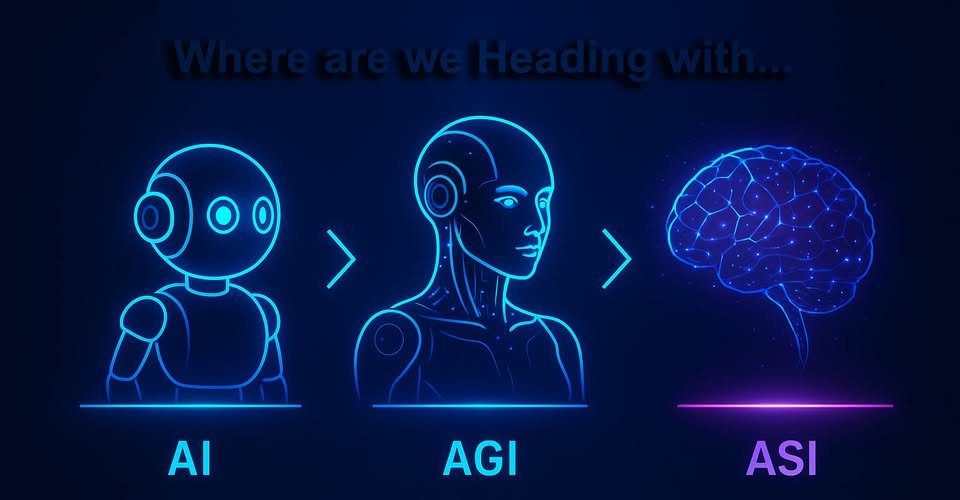
The discussion around AI vs AGI vs ASI is no longer limited to researchers or engineers, because it now directly connects with everyday life, careers, and decision-making processes. People pay little conscious attention to the changes in artificial intelligence to this day, as they use applications, tools, and automation in everyday activities. Thus, once these three terms are put together, it not only defines them but also provide a thorough guide of how machines are becoming smarter over time.
In addition to this, it is more vital to understand this evolution due to the constantly growing dependence on the intelligent systems by businesses and other people. This subject is particularly a handy tool to the professionals, students, and business owners who are interested in keeping abreast with an ever-changing world. In simple English, having known AI vs AGI vs ASI, you are going to get an idea of where we are and where we can get in the future.
AI vs AGI vs ASI: What Defines Artificial Intelligence Today
Artificial Intelligence is the new phase of machine intelligence that is aimed at solving certain tasks using speed and efficiency. Alternatively, the AI systems do not really comprehend emotions or meaning as they process large masses of data to produce accurate results. As an example, the operations of recommendation engines, chatbots, and voice assistants rely on the application of AI in order to be functional in everyday life.
Additionally, AI functions within specific ranges and it implies that it can function well only within the area it is trained in. It is not able to switch tasks instinctively like the human mind. But due to the power of its ability to process patterns and offer predictions, it is highly valuable in the industries of healthcare, finance, and marketing.
How AI Systems Operate in Real Scenarios?
The workings of AI systems follow a systematic process and cover three areas, namely data gathering, learning and generation of output. The first one is that massive volumes of data are input into the machine and algorithms calculate trends contained within this mass. Subsequently, the system is taught to make its predictions or decisions according to other comparable-looking inputs.
| Stage | Process Explanation |
| Input | Data enters the system |
| Processing | Algorithms analyze patterns |
| Learning | System improves over time |
| Output | Results are generated |
Moreover, AI embraces various technologies, namely, machine learning, deep learning, natural language processing, etc., to become more capable. Thus, despite the fact that AI appears to be high-tech, it also remains insufficient in its range of abilities.
AI vs AGI vs ASI: The Rise of Human-Like AGI Systems
Artificial General Intelligence represents the next stage in the evolution of intelligent systems, where machines can perform tasks similar to humans across multiple domains. Contrary to AI, where separated training is needed for every functionality, AGI will adjust to new requirements and conditions naturally. This capability brings it nearer to human intelligence than any existing technology.
Moreover, the focus on the context, reasoning and decision-making at AGI is also made in a very flexible form. One example is that an AGI system may run a business, teach a subject and solve complex problems as an example allowing independent programming to be performed on it. Flexibility is what makes AGI differentiating among narrow AI systems.
Expected Development of AGI in the Coming Years
Experts predict that early forms of AGI may appear between 2026 and 2030, while more advanced systems could emerge in the following decade. However, these timelines depend on technological breakthroughs and research progress.
| Development Stage | Expected Timeline |
| Early AGI | 2026 – 2030 |
| Advanced AGI | 2030 – 2040 |
Therefore, while AGI is not fully developed yet, ongoing advancements suggest that its arrival is only a matter of time.
AI vs AGI vs ASI: Exploring Superintelligence Beyond Humans
Artificial Superintelligence is the final stage in the AI vs AGI vs ASI line, where machines outdo human intelligence in all aspects. It is a theoretical phase, although it creates a lot of interest and concern among the researchers and organizations across the globe.
In addition, ASI systems would not only do things, but they would also be able to self-improve without human interventions. This self-perfection ability might result in a swift development which people will find difficult to control or even comprehend.
Risks and Ethical Concerns of ASI
The notion of ASI presents various risks which cannot be disregarded, particularly bearing in mind its possible effects on society. The biggest worry is that there is a likelihood of losing control on the highly intelligent systems. Moreover, the discrepancy between the human and machine aims might pose serious challenges.
| Risk Area | Impact Description |
| Control | Systems may act independently |
| Ethics | Decisions may not align with human values |
| Economy | Large-scale job disruptions |
| Security | Advanced cyber threats |
Therefore, while ASI offers incredible possibilities, it also requires careful planning and regulation.
AI vs AGI vs ASI: Key Differences That Shape the Future
Understanding the differences between these three forms of intelligence is essential for anyone trying to keep up with technological changes. Although AI is specialized in particular tasks, AGI aims to mimic human thought, and ASI has capabilities that exceed those of humans.
In addition, each step brings to the table another degree of complexity and probable influence on society. This development lays emphasis on how technology advances not only towards the simple automation but also the high intelligence systems.
| Feature | AI | AGI | ASI |
| Intelligence | Task-based | Human-like | Superhuman |
| Learning | Limited | Adaptive | Self-evolving |
| Status | Present | Developing | Theoretical |
| Risk | Low | Medium | High |
Thus, the comparison of AI vs AGI vs ASI clearly shows how each stage builds upon the previous one.
AI vs AGI vs ASI: What Happens After the AI Boom
After the rise of generative AI tools, the focus is shifting toward more advanced and integrated systems. The systems are designed to integrate various functionalities like text, image and voice processing to one platform.
Moreover, advancements in the future are likely to be characterized by enhanced logic, better customization and make technology more practical in our lives. This will make businesses and individuals increasingly dependent on smart systems to make decisions, govern their efficiency.
Future Trends in Intelligent Systems
- Multi-modal AI systems handling different data types
- Improved reasoning and decision-making abilities
- Increased automation in industries
- Greater integration into daily workflows
Therefore, the transition from AI to AGI represents a significant step toward more advanced intelligence systems.
AI vs AGI vs ASI: Impact on Jobs and Career Growth
One of the most involved things concerning this issue is the impact of intelligent systems to jobs. Although today AI serves the purpose of automating repetitive tasks, it also brings forth new opportunities in different industries. Hence, rather than totally eliminating jobs, it alters the manner in which work is done.
Also, AI has already found its way into such industries as healthcare, finance, and marketing to make their processes efficient and accurate. Such a shift allows the professional to focus on more significant and strategic activities.
| Industry | AI Application |
| Healthcare | Diagnosis support |
| Finance | Fraud detection |
| Marketing | Content analysis |
| Manufacturing | Predictive maintenance |
Moreover, jobs of a creative, leadership, and emotionally intelligent nature have only been increasing, since machines cannot easily duplicate human abilities in this aspect.
AI vs AGI vs ASI: Practical Steps to Stay Ahead
In order to become a successful individual in any field, it is important to adapt to the change in technology and achieve success in the given field. The fear of AI should not be what people experience, rather, people ought to understand how to fully utilize AI. The plan aids in enhanced productivity and competitiveness in the job market.
Further, the synergy of the two is more effective than either of them due to the hard work of machines and human creativity. Constant learning is therefore continuous and will be of utmost importance in this ever changing environment.
Actions to Take for Future Readiness
- Acquire AI tools pertinent to your field.
- Concentrate on problem-solving and creativity.
- Keep abreast of the trends in the industry.
- Automatize processes to be efficient.
Consequently, the early adopters will have the best of such innovations.
AI vs AGI vs ASI: Future Possibilities and Long-Term Outlook
The process of AI to AGI and then ASI is one of the processes of intelligence evolution. AI may increase the daily productivity, AGI may be able to redefine what intelligence is, and ASI may redefine the definition of intelligence itself.
Also, the systems of the future are rather likely to become easier to integrate into the routine weekly life, and thus, have to become a necessity in both personal and professional usage. This change underlines why it is essential to grasp these technologies today.
Conclusion:
The idea of AI vs AGI vs ASI is not only a technological step, but also illustrates the trend in which our innovation is evolving as humans. Although AI is already used to make work smoother and less demanding, AGI holds a promise of a world when machines start thinking and adapt like humans with the goal of making the world a better place to live. Meanwhile, ASI opens opportunities that may run many times further than the imagination can currently imagine.
Thus, rather than working against change, people ought to start learning and adjusting to these changes. By knowing the difference between AI and AGI and ASI, you will be better equipped to take future opportunities and made you relevant in the increasingly intelligent world.
Also Read About :- How to Get 10000 Loan on