

The last few years have been a rapid change in software development. Teams update quicker and customers demand spotless functioning across gadgets. Due to this change, manual effort cannot be used as a primary source of testing. It requires fast actions, accuracy, and validity. It is here that the concept of AI in Test Automation starts to change how the teams approach quality. Testers no longer need to waste hours in performing the repetitive duties, but work with intelligent systems that help to make better decisions. Besides, it enables the teams to identify problems earlier, and this minimizes risk in deployment.
Meanwhile, it does not imply the displacement of human expertise. Instead, it can assist testers in performing monotonous tasks and becoming more efficient. This way, organizations that embrace this strategy enjoy speed and confidence in releases. Consequently, the testing process is becoming smarter, quicker, and more attuned to the current modernization requirements.
AI in Test Automation: Meaning and Its Growing Importance
AI in Test Automation emphasizes applying smart algorithms to accomplish testing tasks with a minimum of human intervention. It is based on the patterns of data and user behaviour as well as past test results. Due to this, it keeps on enhancing its capabilities to identify defects and streamline the testing procedure.
In addition, this method has been necessary as the old testing methods cannot adapt to agile environments. Code is delivered as frequently as possible by teams and such a volume cannot be provided by manual testing alone. Thus, smart automation can be used to ensure consistency without more work.
AI in Test Automation: Simplifying Repetitive QA Processes
Many monotonous tasks are involved in testing, including development of a test case, testing script maintenance and development of test environments. However, Waterstone Test Automation puts less of this pressure on AI because it will undertake the automation of these tasks effectively. This makes testers more inclined to analysis and a lesser emphasis on routine work.
Moreover, smart systems have the ability to renew the test scripts automatically as the application alters. This removes the aspect of manual intervention that has to be done regularly. Meanwhile, it also guarantees the accuracy of tests despite software upgrades.
Moreover, it detects unstable tests and eliminates unwanted noise in the outcomes. This enhances accuracy and minimizes bewilderment in analysis. Thus, quicker and more assuring decisions can be produced by teams.
AI in Test Automation: Enhancing Coverage and Accuracy
Fully covering the test is another challenge that the majority of the teams encounter. Nevertheless, AI in Test Automation is a solution to this problem because it uses vast amounts of data and determines patterns that are often overlooked by people. Consequently, it will reveal concealed flaws in a better way.
In addition, it supports multiple types of testing at a time. This gives applications high-performance in a variety of situations and settings. As a result the teams have a better understanding of system behavior.
Types of Testing Improved by AI
| Testing Type | Purpose |
| UI Testing | Detects interface and layout changes |
| API Testing | Ensures seamless integration between systems |
| Regression Testing | Prevents new defects after updates |
| Performance Testing | Evaluates system speed and stability |
| Cross-browser Test | Checks compatibility across platforms |
Having examined these types of testing, it is evident that intelligent automation enhances comprehensive coverage. Consequently, there are reduced problems that go to production and user experience also enhances.
AI in Test Automation Accelerating CI/CD Feedback Cycles
Speed is an important factor concerning modern development pipelines. Thus, quicker feedback gets crucial to quality maintenance. AI in Test Automation combines with a CI/CD pipeline that provides real-time results in testing.
In addition, it gives priority in the execution of tests in accordance with risk and new developments. This helps to make sure that critical issues are brought out early. Due to this, developers are in a position to fix the issues before they get out of hand.
Also, constant testing leads to the minimization of technical debt. As faults are addressed at an earlier stage, the teams escape intricate debugging in the case of later development. This in turn facilitates easier deployment that is more predictable.
AI in Test Automation Challenges and Real Limitations
Intelligent system testing is fast and automated but it is limited by the practice that a team has to realize at the outset. These systems are not bad in the examination of patterns; however, they tend to lack in-depth business awareness. Due to this, the groups have to strike a balance between the automation and human awareness to prevent coverage loopholes.
1. Limited understanding of business context
The intelligent systems are based on data patterns and therefore cannot comprehend the real world forces of users and business requirements. Accordingly, they can overlook situations which seem self-evident to professional testers. Consequently, critical test cases have to be defined by teams manually in such a way that they would correspond to real user behavior.
2. Lack of transparency in decision-making
Some systems give findings without having an explanation on how they came to such conclusions. As a result of this, testers might not be able to trust or authenticate the results. Such indistinctiveness can slow down the debugging process and decrease the confidence of automation results.
3. Over-reliance on automation tools
When automated systems are overly relied on, there is a risk of there being edge cases and uncommon situations that get overlooked by teams. Additionally, the automation can not reveal the rare but important conditions which can be observed only by human testers. As such, balanced approach is a key towards credible results.
4. Dependence on quality training data
Such systems only work well with the correct and relevant data when they are being trained. In case the input data is not of good quality, the results will not be good either. This makes it necessary that the dataset of teams has to be efficient by constantly refining and updating.
AI in Test Automation Implementation Strategy for Teams
Test Automation based on AI needs planning. The teams should, first, test how they have been doing it. This aids in locating places of automation value addition. Then they are to begin with minor implementations. They do not need to change everything all at once, but can specify certain characteristics within the maintenance of tests or detecting defects. In addition, training is important to effective adoption. Teams should know how to utilize tools and how to analyze the results properly.
Implementation Steps
| Step | Action |
| Analyze workflow | Identify repetitive tasks |
| Start small | Implement basic automation features |
| Train team | Provide knowledge and hands-on experience |
| Improve data | Use accurate and updated inputs |
| Scale gradually | Expand usage over time |
After following these steps, teams can gradually build confidence and improve their testing capabilities.
AI in Test Automation Use Cases Driving Real Results
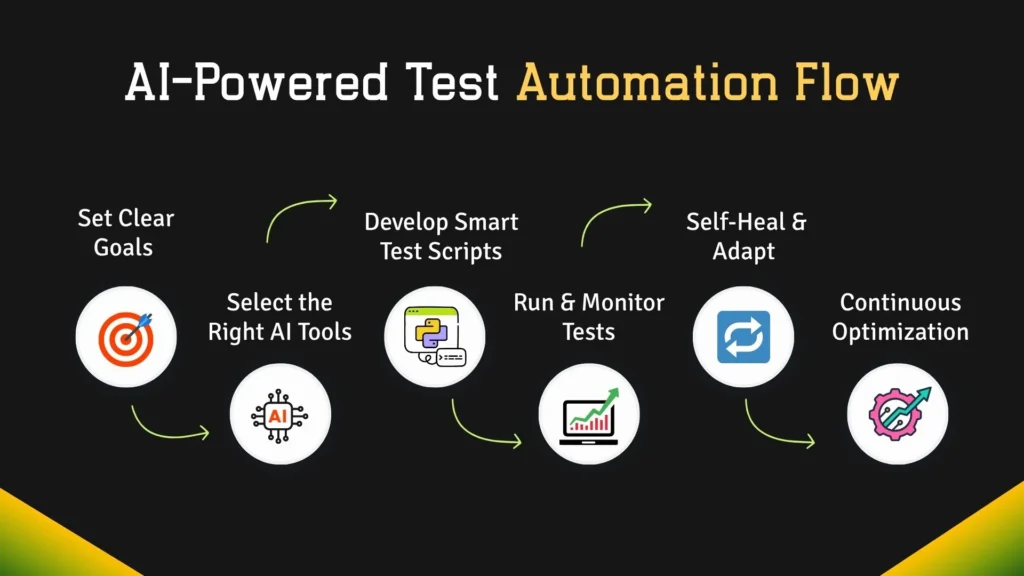
Real-life applications demonstrate how contemporary testing systems enhance efficiency and accuracy in projects. Such applications enable groups to shift toward responsive testing to proactive quality testing. In addition, they enable organizations to identify problems early and provide a high-quality user experience at all times.
1. Automatic test case creation
Systems use past test data to give new test cases, user behavior, and changes to code to create new test cases. This saves time and manual work is minimized thus accelerating the test process. Consequently, teams will be able to work on refining scenarios rather than building them at the beginning.
2. Predictive defect identification
Through observations of the past defects patterns, systems can indicate areas which have greater chances of failure. Thus, teams are able to focus on high-risk parts and strive to fix prior to their failure. This can minimize production flaws and enhance stability.
3. Visual validation of user interfaces
Current testing devices match the screenshots and identify even a slight visual change among versions. Due to this, devices with the same design and functionality can be ensured within teams. This results in more trustworthy and enhances user experience.
4. Intelligent execution of test suites
Systems do not always run all the tests (they can still run the tests periodically), but rather primarily focus on risk-relevant tests. Therefore, priority tests are executed initially and this accelerates the feedback and enhances efficiency. This is also effective in the optimization of resources in the team.
AI in Test Automation Tools and Framework Evolution
The ecosystem of the tools is expanding. Presently, the teams have a variety of sophisticated way of automation testing tools which aid in testing requirements of various teams. The open-source AI testing tools are favored by some organizations due to their flexibility and customization. Although developers will tend to test free tools of automation testing to prove the capabilities first, in case full integration is adopted. These are tools that can be used by teams to learn about intelligent automation in the field.
Moreover, the notion of an ai test automation framework has become prevalent. It integrates various tools and processes to make a single system. Consequently, the teams attain consistency and scalability of testing activities. Due to this development, there are various ways in which organizations can use automation effectively.
AI in Test Automation Learning Path and Skill Development
With the rising adoption, professionals should update their skills. A lot of testers are currently searching using tutorial resources in AI automation testing to get insights into how it works. Furthermore, academic courses like an artificial intelligence in test automation can assist people in gaining knowledge gradually. These courses encompass concepts, tools as well as practical implementations.
Also, practical experience is important. Testing professionals that come to work on actual projects acquire more information on automation practices. Hence, it is necessary to undergo lifelong learning in order to remain competitive. Due to this change, testing has become more analytical and strategic in nature.
Generative AI in Test Automation and Future Possibilities
The introduction of generative ai in test automation has opened new possibilities. It enables systems to automatically generate test cases, scenarios and even documentation. In addition, it enhances the cooperation between the non-technical and technical teams. The system can translate the requirements where the user can specify requirements in simple terms since they can be translated into executable tests.
Also, it decreases the sophistication of test design. Teams need not learn in-depth coding to develop effective tests. Thus there is an enhancement of accessibility among organisations. Due to these developments the future of testing is more intelligent and efficient than ever.
Conclusion:
AI in Test Automation continues to redefine how teams approach software quality. It enhances speed, promotes accuracy, and enables continuous testing through development cycles. Furthermore, it saves on manual labor and enables testers to embrace key analysis. Meanwhile, it needs to be implemented attentively and monitored by people. Balanced teams comprising automation and expertise are the best performers. Thus, a strategized adoption of AI in Test Automation ensures enhanced software quality and success in the long term.
Also Read About :- Edge AI ROI Calculator for Smarter Business Decisions