

A few years ago, startup teams could still manage operations manually without major pressure. Founders handled customer emails themselves, sales teams updated spreadsheets manually, and product managers coordinated workflows through endless Slack messages. That setup no longer works once a startup begins scaling quickly. Tasks multiply faster than teams can manage them, and small operational delays slowly turn into larger productivity problems. That shift explains why more companies are actively searching for smarter workflow systems instead of hiring aggressively too early. Modern startups want software that reduces repetitive work, improves communication, and saves operational hours every single week. This demand pushed ai automation tools for startups into the center of business operations in 2026.
The interesting part is how much these tools have evolved recently. Earlier workflow software mainly moved data between apps. Modern AI systems summarize meetings, classify support tickets, generate responses, route approvals, and even recommend next actions automatically. Some platforms now feel less like automation software and more like digital operational assistants. This article will examine the reality of how modern workflow platforms can be used by startups, which tools are dominating the market, and how founders can select the appropriate automation stack to associate with each of their departments. It also includes the emergence of low-code systems, AI-native workflows, and productivity-oriented platforms that will shape startup activities this year.
What Is an AI Workflow Automation for Startup Teams?
An AI workflow automation is a process where artificial intelligence handles tasks, decisions, and actions across connected applications without constant manual involvement. Traditional automation mostly transferred information from one app to another. AI workflows are even more enhanced since they can contextualize, summarize information and classify requests, as well as produce helpful outputs. This distinction is important since startups are moving towards the use of AI-assisted operations as opposed to simple rule-based automation. Teams desire workflows that have the ability to be intelligent enough to consider repetitive conditions rather than just to obey a set of rules. A real-life example can be found within customer support systems. Upon a customer sending a complaint, the workflow is able to determine urgency, summarize the issue, redirect the request to the appropriate department and write a response prior to an agent opening the ticket.
AI Automation Tools for Startups and Modern Workflow Systems
Most startups do not struggle because of poor ideas. They struggle because teams lose time on repetitive operational tasks that quietly consume entire workdays. Customer follow-ups, onboarding emails, internal approvals, meeting notes, CRM updates, and reporting tasks eventually create operational overload.
That is where ai automation tools for startups become valuable. These systems streamline repetitive work processes and minimise the manual efforts across functions. Alternatively, instead of the employees performing all the little tasks themselves, AI-driven processes perform a great number of operational tasks automatically.
| Startup Workflow | AI Automation Result |
| Customer onboarding | Faster activation |
| Sales follow-ups | Better response consistency |
| Internal approvals | Reduced delays |
| Reporting workflows | Less manual work |
| Support ticket routing | Faster resolution |
The strongest workflow systems help startups reduce operational friction instead of creating additional software complexity.
Best AI Automation Tools for Small Startups in 2026
Small startups rarely have extra engineering resources available for workflow management. Founders, marketers, and product teams often manage operations themselves during early growth stages. That is why simplicity matters so much. The most useful AI automation systems on small startups are more usable, easy to install, and light workflow. Teams must have systems that they can roll out within short periods without protracted implementation periods.
Several startups begin with one simple automation workflow. They connect forms, CRMs, and communication tools together. Once teams experience time savings directly, they gradually expand automation into customer onboarding, reporting, support systems, and sales processes.
| Tool Type | Best For |
| Visual workflow builders | Non-technical teams |
| Open-source systems | Technical startups |
| Managed automation services | Small operations teams |
| AI assistants | Founder productivity |
One startup founder recently shared how automating onboarding reminders and sales follow-ups saved nearly twelve operational hours every week. That improvement allowed the company to focus more on customer retention and product improvements. The rise of best AI automation tools for small startups reflects how lean teams now operate. Startups want faster workflows without expanding headcount unnecessarily.
Free AI Automation Tools for Startups Worth Trying
Not every startup wants to spend heavily on automation immediately. Early-stage companies often prefer testing workflows through free plans before upgrading later. Fortunately, several platforms now offer enough functionality inside their free tiers to support meaningful operational workflows. The challenge appears once workflow execution volume increases. Some free plans limit integrations, automation runs, or advanced AI features. Still, free platforms remain useful for validating operational ideas during early growth stages.
Several free AI automation tools for startups work surprisingly well for smaller workflow requirements.
| Free Tool | Best Use Case |
| Zapier | Basic SaaS automations |
| Make | Multi-step workflows |
| n8n | Open-source workflows |
| Pipedream | API-heavy automation |
| Vellum | Personal AI productivity |
Some founders make the mistake of overbuilding automation too early. Simpler workflows usually create better operational results during the beginning. Teams should automate repetitive tasks first instead of trying to automate everything immediately. That practical approach helps startups avoid workflow chaos later.
What Are Low-Code AI Workflow Automation Tools?
Low code workflow systems enable visual interfaces in designing automations rather than complex code. The majority of systems are based on drag-and-drop workflow builders, in which users program by wiring applications, actions, conditions, and AI steps. This transition transformed the way start ups work as the non-technical teams have independent workflow development. Not all workflow adjustments require engineers, as product managers, operations staff, and marketers can do it themselves.
The most powerful low-code programs are simple and flexible at the same time. Novices are able to create workflows with a single, fast interaction, and technical groups are free to access APIs, custom code, and sophisticated integrations at a later date.
Core Features in Low-Code Workflow Platforms
| Feature | Startup Benefit |
| Visual builder | Faster setup |
| AI actions | Smarter workflows |
| Integration support | Better scalability |
| Workflow logs | Easier debugging |
| Approval systems | Better control |
The popularity of op AI automation tools for startups also increased because founders now expect automation platforms to support AI reasoning instead of simple trigger-based logic alone.
Why Startups Use Low-Code AI Workflow Automation Tools?
Operational pressure increases rapidly once startups grow beyond small founding teams. Customer requests increase, sales workflows become larger, and internal coordination gets harder. Without automation, teams waste significant time repeating small administrative tasks daily.
Low-code workflow systems solve that problem by reducing operational friction across departments. Teams automate onboarding, reporting, support handling, lead routing, and approvals without writing heavy backend systems.
One ecommerce startup reduced order management delays by connecting inventory tools, Slack notifications, and AI-generated customer updates together through automation workflows. The team reported noticeable improvements within two weeks.
Who Needs Low-Code AI Workflow Automation Tools?
Not every company needs advanced automation immediately. Still, startups handling repetitive operational workflows usually benefit from automation earlier than expected. SaaS companies automate onboarding and support workflows. Ecommerce startups automate order communication and inventory updates. Marketing agencies automate campaign reporting and lead tracking. Product teams automate feedback collection and internal notifications.
The strongest adoption appears inside fast-moving companies where workflow volume increases faster than hiring capacity.
Teams That Benefit Most
| Team Type | Typical Workflow |
| SaaS startups | Customer onboarding |
| Marketing teams | Campaign reporting |
| Sales teams | Lead qualification |
| Ecommerce brands | Inventory alerts |
| Product teams | Feedback workflows |
The conversation around best startup AI tools in 2026 often centers around operational efficiency rather than flashy AI features alone.
What Makes an Ideal AI Workflow Automation Tool?
Many workflow platforms look impressive during product demos, yet practical usability matters far more once workflows enter production. A useful automation system should reduce operational work instead of increasing software management overhead.
The best platforms usually combine ease of use, AI-native actions, workflow visibility, integrations, testing systems, and scalability together. Simpler interfaces help non-technical users, while technical teams still need deeper customization options later.
Important Features Startups Should Evaluate
| Feature | Why It Matters |
| AI workflow actions | Smarter automation |
| Workflow testing | Prevents failures |
| Error handling | Better reliability |
| Cost tracking | Easier budgeting |
| Security controls | Safer operations |
Several startups now prioritize debugging visibility during software evaluation because broken workflows can quietly damage operations if teams cannot identify issues quickly.
Key 2026 Trends in AI Workflow Automation Tools
The workflow automation industry changed rapidly during the last year. Features that once felt advanced now appear inside standard workflow systems. AI evaluations became a major buying factor because startups want safer workflow updates before deployment. Teams also demand stronger governance systems, prompt version tracking, and operational visibility.
Another noticeable trend involves proactive AI systems. Instead of waiting for prompts, some platforms now identify recurring patterns and suggest operational actions automatically.
| Trend | Operational Impact |
| AI evaluations | Safer deployments |
| Workflow observability | Better debugging |
| Proactive AI systems | Smarter operations |
| Local-first AI | Better privacy |
The strongest ai automation tools for startups increasingly focus on operational quality instead of only integration quantity.
How to Evaluate AI Workflow Automation Tools
Choosing automation software based only on marketing pages usually creates problems later. The smarter approach is testing a real operational workflow before committing fully. Startups should evaluate workflow usability, scalability, debugging quality, AI capability, integrations, and pricing structure carefully.
Questions Startups Should Ask
| Evaluation Area | Key Question |
| Ease of use | Can non-technical teams manage workflows? |
| Workflow scalability | Will automation survive growth? |
| AI functionality | Does it support smart actions? |
| Security | Are permissions available? |
| Cost model | Is pricing predictable? |
One remote startup tested three workflow platforms before selecting Make because its visual debugging system reduced troubleshooting time significantly for operations staff.
10 best startup AI tools in 2026
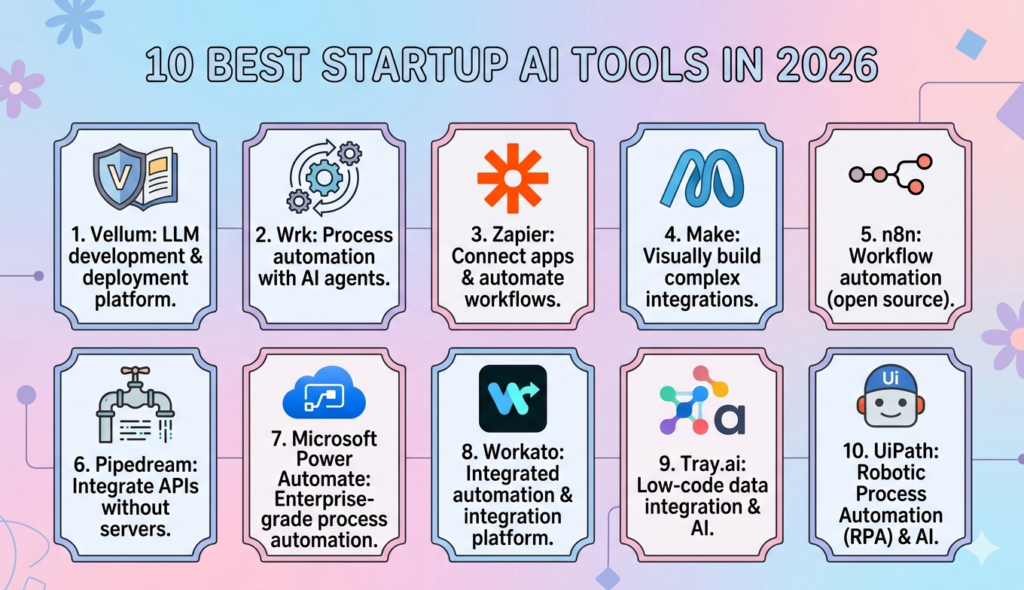
Modern startups now have access to dozens of workflow automation platforms, yet only a handful consistently dominate operational conversations. Some platforms focus on beginner-friendly automations while others specialize in enterprise-grade workflow management.
The tools below stand out because of practical usability, operational reliability, AI capability, and workflow flexibility.
1. Vellum
Instead of working with the workflow diagrams, Vellum concentrates on the personal productivity automation. The platform automates behavior of a user with time and assists in scheduling, research, reminders, follow-ups, and repeated operational tasks. It is favorable to numerous founders and creators as the AI is active rather than passive, requiring manual indications on repeated occasions.
2. Wrk
Wrk adheres to managed automation model with internal team developing and sustaining workflows of its customers. This configuration is ideal when a startup is seeking the benefits of automation in a limited amount of time but they have no internal engineering infrastructure to handle workflow. Along with the human approval mechanisms and OCR systems, the AI workflows are also supported on the platform.
3. Zapier
Zapier is still one of the least complex workflow automation tools that can be used by startups and small businesses. Its easy drag-and-drop workflow designer and massive integration platform enable non-technical users to find it easier to automate. The vast majority of startups start with Zapier since the workflows can be initiated in the fastest time and without any complex setup.
4. Make
Make is a useful tool of operation staffs, as it enables advanced routing of workflow, graphics debugging, and multi-level automation logic. The platform allows the user to have more workflow control whilst keeping a visual interface to make it easier to manage. Make is used by startups that process large operational workflows instead of a less complex automation system.
5. n8n
Technical startups were able to use n8n quite often due to its open-source adaptability and self-hosted deployment options. Developers have the ability to customize workflows to the lowest level, but still retain full control of infrastructure. It is particularly effective with startups that process sensitive data or have complicated operations based on APIs.
6. Pipedream
Pipedream is primarily meant to serve in developer workflows, built on APIs, scripting, and event-driven execution. It supports JavaScript, Python, TypeScript and automatically manages backend infrastructure. Pipedream is a favorite with technical startups in need of quick experimentation in their workflow and API integrations.
7. Microsoft Power Automate
Microsoft Power Automate is embedded with Microsoft products, such as tools like Teams, Outlook, Azure, and Dynamics. One of the reasons why Microsoft ecosystems are preferred by businesses that use it already is that workflows are easy to connect across the internal tools. It also integrates desktop automation with cloud operations to provide augmented operational support.
8. Workato
Workato is concerned with large-scale integrations, workflow monitoring, enterprise-level automation, and governance. It is commonly applied by larger startups and growing companies when the complexity of operations becomes apparent within departments. The platform enables better workflow visibility and collaboration as opposed to simpler automation systems.
9. Tray.ai
Tray.ai is built for API-heavy workflows where companies require advanced data mapping and debugging systems. Operations and product teams often use it to manage large workflow architectures involving multiple SaaS tools. Its workflow flexibility makes it useful for mid-sized startups scaling operational systems rapidly.
10. UiPath
UiPath remains one of the strongest robotic process automation platforms for enterprise workflow automation and desktop task handling. The platform combines AI-based document processing, computer vision, and automation workflows together. Large organizations commonly use UiPath for repetitive operational tasks involving legacy systems and manual processes.
Low-Code AI Workflow Automation Tool Comparison
| Tool | Best For | Main Strength | Starting Price |
| Vellum | Personal productivity | AI memory system | Free |
| Zapier | Beginners | Easy integrations | Free |
| Make | Operations workflows | Visual logic builder | Free |
| n8n | Technical teams | Open-source control | Free |
| Wrk | Managed automation | Done-for-you workflows | Paid |
| Workato | Enterprises | Governance systems | Enterprise |
Choosing the right platform depends more on operational needs than software popularity.
Why Vellum Stands Out Among AI Workflow Platforms
Vellum stands apart because it focuses on individual productivity workflows instead of only organizational automations. Most workflow systems reset after every execution. Vellum maintains context and memory across workflows. That difference creates a more proactive operational experience for founders, creators, and productivity-heavy professionals managing recurring tasks daily.
What You Can Do in Your First Week With Vellum
Most users begin by connecting their calendars, task systems, emails, and communication tools together. During the first few days, the platform learns recurring workflow patterns and operational behavior. By the end of the week, many users automate scheduling coordination, reminders, meeting preparation, and follow-up handling without repeated prompting.
Conclusion
The rise of ai automation tools for startups reflects how modern companies now operate with leaner teams and faster operational demands. Startups no longer treat automation as optional productivity software. It became part of everyday operations because repetitive work quietly slows growth once workflows increase.
The smartest founders usually begin with smaller workflows that remove immediate operational bottlenecks. After seeing practical time savings, they gradually expand automation across departments. That measured approach creates smoother operations without overwhelming teams with unnecessary complexity.
The strongest workflow platforms in 2026 combine automation, AI reasoning, workflow visibility, and operational flexibility together. Whether startups prefer Zapier for simplicity, Make for advanced routing, n8n for open-source control, or Vellum for proactive productivity workflows, the real advantage comes from reducing repetitive operational work consistently.