

Technology no longer evolves in a straight line. It now expands in layers, combining multiple innovations at once. Within this evolving landscape, The Future of AI is anchored on a singular robust thought machine needs to know how to perceive the world like humans. This is not only reading, but also viewing images, listening, and relating all these in each other. Nowadays, the world demands smarter systems by the companies and the users. They desire responses that are natural, pertinent, and rapid. Due to this shift, multimodal AI has been taking the rear seat in innovation. It enables systems to handle various data concurrently, resulting in a deeper comprehension and improved outcomes. The Future of AI is moving towards real-world context intertwined with intelligence in its systems as industries continually adapt.
A Clear Perspective on Multimodal AI in The Future of AI
Multimodal AI does not merely represent a technological upgrade. Rather, it is a fresh perspective towards the way machines process information. Early systems concentrated on a single type of data, like text or images. But current systems integrate several inputs to phase out more enriched outputs.
In a real-life context, multimodal systems enhance all aspects of search results to robotization. They minimize ambiguity and assist the machines to understand complex inputs better. As such, they are essential in enhancing decisions and user interaction in businesses.
Core Structure of Multimodal AI Systems
Multimodal AI works based on a designed architecture. A particular component is involved in a particular process to achieve a seamless processing and correct outputs.
| Module | Description | Examples/Techniques |
| Input Module | Collects and processes different data types like text, images, and audio | Voice input, visual recognition |
| Fusion Module | Combines and aligns multiple data sources for better understanding | Early fusion, intermediate fusion, late fusion |
| Output Module | Generates final results based on combined inputs | Text output, predictions, visual responses |
Such an arrangement guarantees smooth data transfer between stages. In addition, it enables systems to be flexible to various use cases. Consequently, The Future of AI keeps on being updated with the more flexible and scalable solutions.
How Multimodal AI Systems Process Data in the Future of AI?
To perceive and integrate diverse kinds of data, multimodal systems take a systematic route, which assists them to give precise and context-qualified performances in real-life contexts.
Step 1: Data Collection and Preparation
Initially, systems collect information through various means like text, images, audio and video. Then they standardize and clean the data in order to eliminate inconsistencies. The step will guarantee the uniformity of all the inputs prior to processing.
Step 2: Feature Extraction from Each Input
Next, each type of data is extracted by systems to give meaningful features using specialized models. As an example, language models are used to process text and visual models are used to process images. Consequently, any input will be converted into a form that can be used to process it.
Step 3: Cross-Modal Alignment of Data
After extracting features, systems bring them into correspondence so that the features correspond to the same concept. This step of alignment relates various types of data, and it enhances comprehension. Hence, the system is able to match an image with a text or audio input.
Step 4: Fusion of Multiple Data Sources
After alignment, systems combine all inputs into a unified structure using fusion techniques. The techniques provide holistic data processing by the system and not data processing individually. As a result, the generated output is more relevant and contextually aware.
Step 5: Output Generation and Refinement
Lastly, the system creates a result that is informed by data aggregates. It can generate text as well as visuals or even predict what to do based on the task. Also, after-processing enhances clarity, and the output satisfies the user’s expectations.
Multimodal AI Is Reshaping The Future of AI Landscape
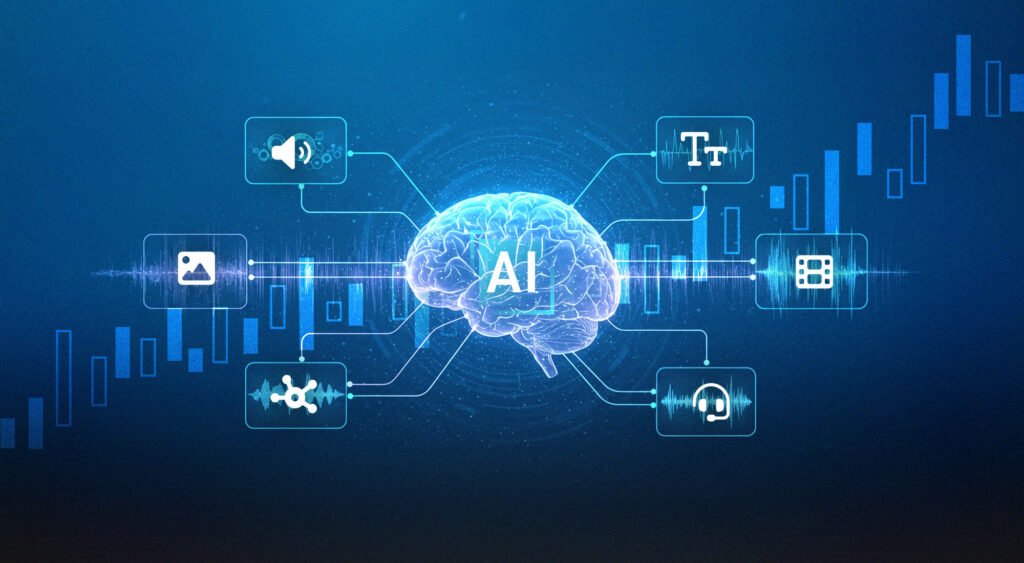
Multimodal AI has an effect beyond technical enhancements. It changes the level of interaction of users with technology. In the past, the systems had to have organized inputs. Now, people can use voice, pictures and text to communicate intuitively.
This configuration enhances user experience. An example is virtual assistants learning how to respond to a tone, context, and graphics. Due to this, they are more responsive. Thus, The Future of AI is concentrated on developing systems that are intuitive and human-like.
Moreover, multimodal AI has an increased level of understanding a context. When systems examine several types of data simultaneously, they have a better idea of scenarios. The feature comes in handy to analyze videos, real-time communication, and automation.
Key Changes in the AI Landscape
- Improved human-machine interaction
- Better context understanding through combined data
- Increased adoption across industries
- Enhanced accessibility using voice and visual tools
Because of these improvements, organizations invest heavily in multimodal technologies. Consequently, The Future of AI continues to evolve at a rapid pace.
5 Business Use Cases Driving The Future of AI
Multimodal AI is widely embraced by businesses in various industries to enhance efficiency and innovation. These systems deal with multifaceted information and provide action-able insights. Consequently, organizations- decisions lead to better production and greater organization.
Industry Use Cases:
| Industry | Application | Benefit |
| Healthcare | Combining patient data with imaging | Accurate diagnosis |
| Retail | Customer behavior analysis | Personalized marketing |
| Education | Adaptive learning systems | Better engagement |
| Automotive | Sensor-based navigation | Improved safety |
| Entertainment | AR and VR experiences | Immersive interaction |
These applications are clear examples of how The Future of AI relates to real-life applications. Moreover, they emphasize the need to integrate data to achieve improved outcomes.
The Role of Multimodal AI in Industry Transformation
Multimodal systems are changing the industry because it enhances the way organizations process information and make their decisions. They help businesses to integrate various data sources, which results in improved insights and performance.
1. Enhanced Decision-Making Across Sectors
Multimodal systems are used to evaluate and process large amounts of structured and unstructured data in organizations. This method will help the decision-makers get better insights into patterns. Therefore, they can make quicker and better decisions.
2. Improved Customer Experience and Engagement
Businesses are now communicating with customers in various input formats, which include voice, pictures and texts. It is more natural and responsive in this interaction. This way, businesses enhance satisfaction and the level of engagement with customers.
3. Increased Efficiency in Operations
Multimodal systems are used to automate complex tasks using inputs in multiple sources. This saves manpower and enhances productivity. Thus, companies accomplish more using less.
4. Expansion of Accessibility and Inclusivity
The systems will help advance accessibility as they turn text into speech and identify images. This capability assists users who may have varied requirements to get along with technology easily. This leads to an increased number of people being subjected to digital solutions.
Challenges in Implementing Multimodal AI Systems
The current systems are oriented to enhancing the interaction with users by enabling people to interact with natural ways of communication in various formats. This practice will make online experiences easier and more interactive.
1. Natural Communication Through Multiple Inputs
Users can also integrate voice, text and images when interacting with systems. This flexibility lessens work and enhances convenience. Through this, communication is made easier and more effective.
2. Personalized Responses Based on Context
The systems learn user behaviors and preferences to respond with specific responses. This customization enhances satisfaction and instills confidence. Thus, users are more attached to the site.
3. Faster and More Accurate Outputs
Systems negate ambiguity by converting many inputs to give accurate outcomes. This enhances efficiency and time saving. As a result, users have improved performance at reduced effort.
4. Improved Engagement Across Platforms
The interaction with systems enhances user interaction with applications and services via multimodal interactions. It provides an engaging effect that keeps users engaged. So, retention and use rates increase on platforms.
How Expert Support Accelerates The Future of AI Adoption?
Companies are not averse to enlisting professional assistance in order to make the adoption of multimodal AI a success. The services of the professionals assist businesses in assessing their readiness and creating effective strategies. The services also help in choosing the appropriate models depending on certain needs.
Additionally, experts provide continuous testing and optimization. This will guarantee efficient operation of systems across conditions. Moreover, state-of-the-art analytics assists the organizations to crunch data on real time, which enhances decision-making.
Key Areas of Support
- AI strategy development and planning
- Model selection and customization
- Continuous testing and optimization
- Data compliance and quality assurance
With the right support, companies will be able to push through the hardship and deliver quantifiable results. Thus, The Future of AI is more affordable to both large and small organizations.
Emerging Trends Strengthening The Future of AI
There are various tendencies that will further determine the development of multimodal AI. First, the systems are moving towards being context-aware. They understand not just data, but also user intent. Second, AR and VR are technologies that can be integrated to provide immersive experiences.
In addition, automation is also growing in industries. Systems are used to deal with complicated tasks with little human interference. Meanwhile, the process of personalization is enhanced due to the fact that AI is customized to the user preferences. Such trends make The Future of AI trend towards more intelligent and responsive systems. Due to this, businesses will also need to keep up to date in order to be competitive.
Conclusion:
Multimodal innovation is still developing the Future of AI and engages multiple types of data to provide smarter and more accurate outcomes. With the implementation of these systems by industries, they become more efficient, increase user experience, and open up new possibilities. This revolution emphasizes the role of contextually minded intelligence in the present technology.
Meanwhile, such issues as data quality and integration need to be prepared by the businesses. But these barriers can be conquered through proper strategies and through the help of experts. Finally, The Future of AI will be based on the success of systems in recognizing and responding to the real world situations, and technology will be more human and realistic.
Also Read About :- Manual vs Automation Testing